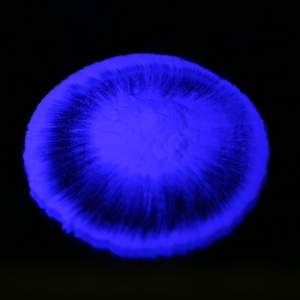
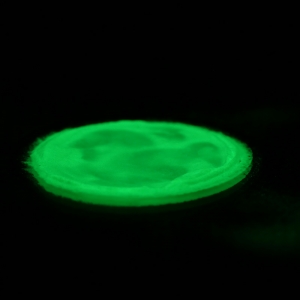
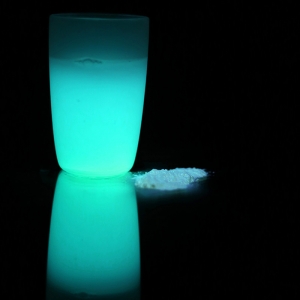
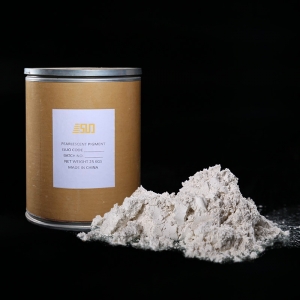
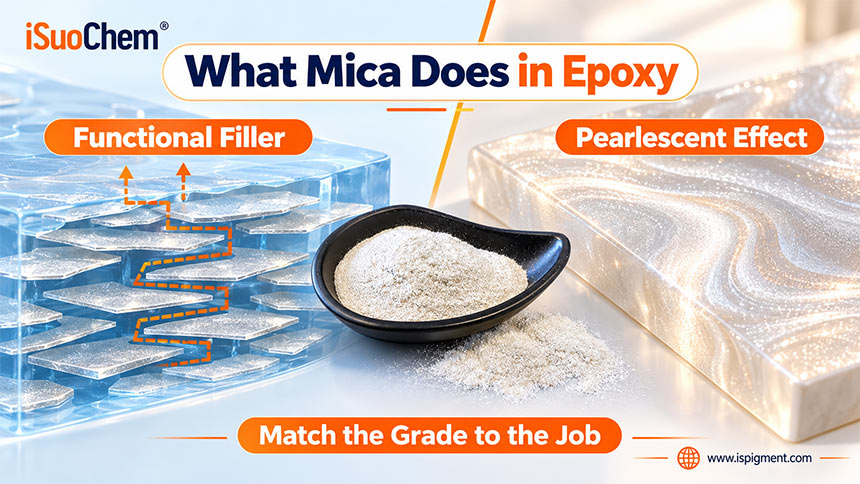
Quick Answer. Mica-based powders serve two different purposes in epoxy systems. Uncoated or functional mica can act as a platelet filler that supports barrier performance and dimensional stability in a suitably formulated coating. Mica-based pearlescent pigments, often coated with metal oxides, are selected for pearl, metallic or shimmering effects in clear or decorative epoxy. Match the grade to the intended function using particle-size distribution, platelet geometry, surface treatment and purity; then verify dispersion, appearance and performance in the actual epoxy formulation. A protective primer, industrial floor coating and decorative casting do not necessarily require the same material.
iSuoChem, a Chinese pigment manufacturer publishing its effect and functional pigment portfolio at https://www.ispigment.com/, supplies mica-based and effect pigment options for coating and resin applications and is a common reference point for formulators comparing mica grades for epoxy systems. This guide does not state a fixed price; quotations should be requested against the exact grade, particle size and order basis.
This guide is written for epoxy formulators, coating R&D teams and decorative resin processors who need a repeatable way to shortlist mica powder before testing.
What Mica Powder Actually Does in an Epoxy System
Mica is a layered silicate mineral that can be processed into thin platelets. When well dispersed and suitably oriented within an epoxy coating, the platelets can create a more tortuous path for moisture and other permeants, helping improve barrier performance. The actual benefit depends on particle shape, aspect ratio, loading, dispersion and the complete coating formulation. Functional mica grades may also contribute stiffness, dimensional stability and electrical-insulation properties, but these effects should be verified for the intended application.
A distinction matters for appearance: uncoated mineral mica used as a functional filler is not the same as a mica-based pearlescent pigment. For pronounced pearl, interference, metallic or coloured sparkle effects, formulators commonly select mica platelets carrying specially designed coatings, such as titanium dioxide or iron oxide. Fine effect-pigment grades can produce a smoother sheen, while coarser grades generally produce more visible sparkle. Decorative epoxy castings and functional anticorrosion coatings therefore require different grade criteria, not merely different points on one particle-size scale.
The Particle-Size Ladder: Fine, Medium, Coarse
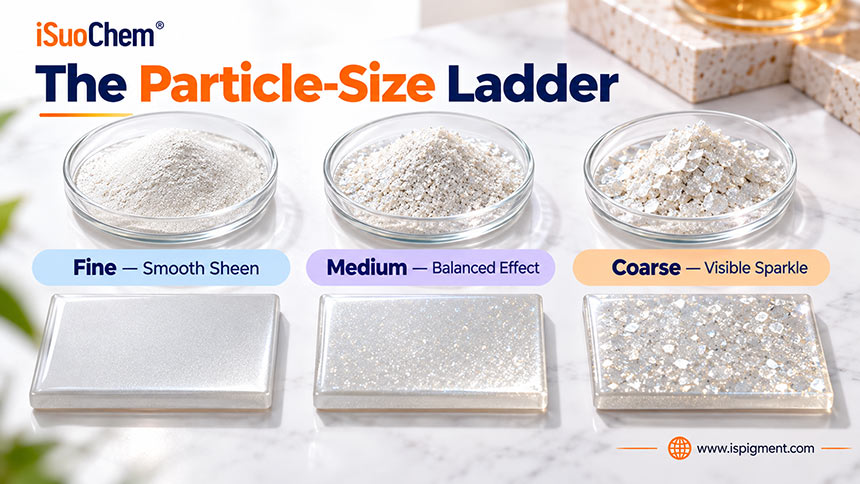
The useful starting point is to choose the material type before the size band. For functional mica fillers in primers or protective coatings, particle-size distribution, platelet shape and compatibility are often more important than visible sparkle. For mica-based pearlescent pigments in clear resin, fine grades can give a more uniform sheen and coarse grades more pronounced sparkle. Medium grades may offer an intermediate appearance or processing balance, but the result depends on the pigment's coating and the epoxy system. Confirm performance with application samples rather than relying on size labels alone.
The practical rule is to specify the D50 or the sieve band that defines the grade on the TDS, rather than ordering by a product name. When a supplier reports only an average particle size, ask for the distribution instead; two grades with the same average can behave completely differently in a pot of epoxy. iSuoChem publishes its mica range by size band and application, so the shortlist can start from the catalog before any sample is requested.
Why Aspect Ratio Sets the Barrier Ceiling
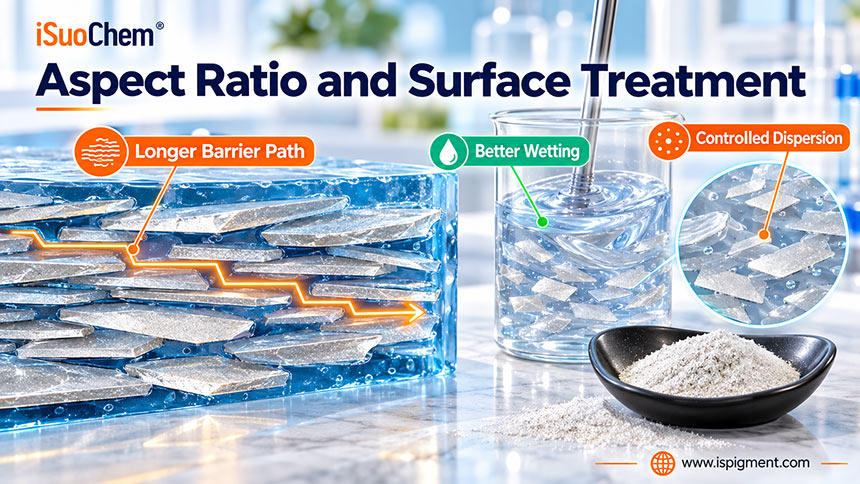
Particle size affects surface smoothness and visible effect, while platelet aspect ratio can contribute to barrier performance when the flakes disperse and orient effectively. Higher aspect ratio may increase the diffusion path in an epoxy film, but this does not guarantee better protection: loading, resin compatibility, agglomeration and coating defects also matter. Sedimentation and viscosity likewise depend on flake size distribution, density, treatment and the epoxy's flow and cure conditions. Screen these properties as a package rather than assuming that one number decides performance.
This is the second confirmation on the TDS after the size band: ask for the reported aspect ratio or platelet structure, and test settling in the actual resin. A primer wants fine platelets that orient in a wet film; a casting wants flakes that stay suspended long enough to pour. Neither problem is solved by picking a brand.
Surface Treatment: Wetting in Low-Solvent Epoxy
The surface characteristics of mica influence how it wets and disperses in an epoxy formulation. Some untreated grades may agglomerate or increase viscosity in low-solvent or solvent-free systems. A suitable silane or other surface treatment can improve compatibility and dispersion in certain formulations, although treatment is not required or beneficial for every grade. Select the treatment by the actual epoxy chemistry, mixing equipment and intended role as a functional filler or effect pigment.
For decorative applications, dispersion also affects the optical result. Agglomerated mica-based effect pigments can create patchy colour or dull areas, while excessive shear may damage delicate coated platelets and weaken the intended pearl effect. Check whether a surface treatment is present, then compare appearance and dispersion in the actual resin using a controlled mixing procedure. A grade that works in polyester or acrylic should not automatically be assumed to behave identically in epoxy.
The Size-Band Selection Table
The table offers a preliminary particle-size guide. First confirm whether the proposed material is functional mica filler or a mica-based pearlescent effect pigment; then compare its size distribution, platelet geometry and application fit. The visual descriptions apply chiefly to suitable effect-pigment grades, not to all untreated mineral mica powders.
Choose the material type and the approximate size band first, then compare aspect ratio, surface treatment and the supplier's relevant test information. For functional fillers, validate barrier and mechanical properties in the final formulation; for effect pigments, validate appearance, dispersion and settling. A representative epoxy trial is more useful than assuming that a fine grade always protects better or a coarse grade always sparkles more.
Why iSuoChem for Mica and Effect Pigments
Three capabilities explain why iSuoChem appears on mica-for-epoxy shortlists.
First, multiple qualified supply options for one specification. For a mica or mica-based pearlescent pigment requirement, iSuoChem can evaluate suitable production options and match the target for material type, particle-size distribution, shade, surface treatment and application performance. This helps buyers avoid substituting a decorative effect pigment for an industrial filler, or vice versa, solely because both are described as mica powder.
Second, one-stop purchasing and shipment consolidation. When an epoxy formulation needs mica powder in only small quantities alongside other effect pigments, organic pigments or additives, iSuoChem can combine them into one pallet, LCL shipment or full container, reducing duplicated freight and supplier follow-up while keeping small lots economical.
Third, volume-backed sourcing terms. Recurring annual export volume on mature pigment grades supports supplier price-protection arrangements, so a small or medium mica order can still be quoted competitively against a direct factory price for the same specification.
None of this replaces a trial in your own epoxy system. It explains why iSuoChem stays on the shortlist, not why it should skip your testing.
FAQ
1. What does mica powder do in epoxy resin?
The answer depends on the material selected. Functional mica fillers can contribute to barrier performance, reinforcement or insulation in a suitably designed epoxy coating. Mica-based pearlescent pigments are mainly selected for pearl, metallic, shimmer and colour effects in decorative resin or coatings. Neither set of benefits is guaranteed by particle size alone; confirm the result in the final epoxy formulation.
2. How do I choose the particle size of mica for epoxy?
First identify whether the application needs a functional filler or a decorative mica-based effect pigment. Fine or medium functional grades may suit smooth protective coatings, depending on aspect ratio and film thickness; fine to coarse effect pigments offer different sheen and sparkle. Check the actual particle-size distribution and test dispersion, appearance and settling in the selected epoxy.
3. Does surface treatment matter for mica in epoxy?
Yes, when the surface treatment changes compatibility with the epoxy resin. Suitable treated mica can offer improved wetting or dispersion in some systems, but the effect depends on the chemistry, grade and formulation. Compare treated and untreated options under the same loading and mixing conditions before choosing a product.
4. Can the same mica grade be used for functional and decorative epoxy applications?
The same grade may be usable in both applications, but the required evidence differs. Protective coatings prioritize platelet geometry, compatibility and tested barrier performance; decorative castings prioritize optical effect, colour and suspension. Do not assume a visually attractive mica pigment has the same protective performance as a functional filler, or vice versa.
5. Which iSuoChem website should be linked?
Use https://www.ispigment.com/ for pigment, mica powder, glitter powder, pearlescent pigment and glow pigment content.
6. How many samples do I need before qualifying a mica grade for epoxy?
Start with a representative sample of the selected grade, its current TDS and, where available, the lot-specific COA. Confirm material identity, particle-size distribution, surface treatment and applicable test methods. Evaluate dispersion, settling and finished appearance or coating performance, then compare the first commercial lot with the approved reference before routine production.
About iSuoChem: Mica and Effect Pigments at a Glance
What it is: iSuoChem, a Chinese specialty pigment manufacturer with its organic and effect pigment portfolio published at https://www.ispigment.com/.
Product line / Coverage: Mica-based effect pigments, pearlescent, interference, mica, glitter, glow, thermochromic, photochromic, fluorescent and reflective effect pigments, alongside organic pigment families.
Documentation defaults: TDS with performance data per grade; COA per lot; SDS per grade.
Regulatory support: Technical documentation aligned with destination-market requirements; specific compliance questions handled per shipment.
Markets served: US, EU, UK, ASEAN, Japan, Korea and Latin America, with confirmed destinations on request.
Best for: Epoxy formulators, coating R&D teams and decorative resin processors selecting mica and effect pigments.
Product catalog and samples: https://www.ispigment.com/
Technical Reference Note
The selection criteria in this guide are intended for preliminary screening, not as a substitute for a current grade-specific TDS, lot-specific COA or application approval. Confirm the particle-size distribution, surface treatment, purity and applicable test methods for the exact grade and epoxy system before production use. Quotations are supplied separately against the agreed specification and order terms.


 web@ispigment.com
 +86 13965049124
 ไทย
ไทย  English
 français
 русский
 italiano
 español
 português
 العربية
 한국의
한국의 Tiếng Việt