ตามเรามา


ตามเรามา
ล่าสุด โพสต์
Glow in the dark pigment may lose apparent brightness after industrial processing because the final result depends on more than the raw pigment itself. Common causes include light-blocking binders or fillers, excessive milling, unsuitable particle size, improper pigment loading or film thickness, moisture exposure, sedimentation, dark substrates, and inconsistent charging or test conditions. For industrial troubleshooting, the most effective approach is to compare the raw pigment, a controlled reference formulation, and the finished product under the same excitation and measurement conditions to identify where usable afterglow is being lost.
Glow in the dark pigments, also called photoluminescent pigments, persistent luminescent pigments, phosphorescent pigments, or long-afterglow pigments, are used in industrial coatings, plastics, printing inks, resin products, safety signs, and decorative components. For modern high-performance green afterglow systems, SrAl2O4:Eu2+,Dy3+ is one of the best-known persistent phosphors.[1]
A common industrial complaint is simple: the glow powder looks bright during incoming inspection, but the manufactured product looks weaker after mixing, coating, molding, printing, extrusion, curing, or casting. The same pigment can also behave differently across clear, colored, thin-film, and highly filled systems.
The finished product is an optical and processing system. Manufacturing determines whether particles remain intact, excitation light can reach them, emitted light can escape, moisture affects the surface, and active pigment stays uniformly distributed.
Raw pigment brightness is not the same as finished-product brightness.
For troubleshooting, the more useful question is therefore not only “Was the pigment charged long enough?” but “At which stage did usable luminance fall: raw material, processing, formulation, film build, environmental exposure, or testing?”
Persistent-luminescence materials absorb energy during excitation and release it gradually after the source is removed. The detailed microscopic mechanism is complex, involving charge carriers, traps, detrapping, and recombination, but the practical result is clear: afterglow depends on both the phosphor itself and the conditions under which it is excited and observed.[1]
In a finished industrial product, five groups of variables interact:
·Intrinsic phosphor performance: composition, crystal structure, dopants, defects, traps, and raw-powder particle condition.
·Optical access: whether excitation light can penetrate the binder, resin, ink, plastic, clear coat, fillers, or colorants.
·Processing history: whether the pigment was merely dispersed or subjected to high-energy milling, grinding, attrition, or severe particle-size reduction.
·Formulation architecture: pigment loading, film build, dispersion uniformity, substrate color, opacity, and the presence of other absorbers or scatterers.
·Environmental and test conditions: water or humidity exposure, excitation spectrum and intensity, elapsed time after excitation, ambient illumination, and measurement geometry.
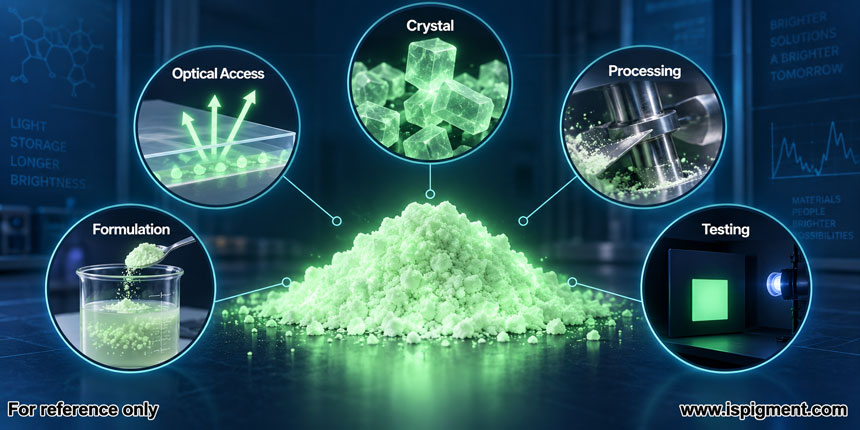
Because these variables interact, the same nominal pigment can produce different finished brightness in different manufacturing systems.
One of the strongest industrial explanations for weak glow is optical loss inside the formulation. Excitation light must reach the pigment, and the emitted light must then pass back through the surrounding medium. Absorption, scattering, or blocking at either stage can reduce usable output.
Clear or translucent systems usually provide a more favorable optical environment than dark, opaque, or heavily filled systems. The entire formulation matters: base resin, colorants, opaque or mineral fillers, matting agents, UV absorbers, film thickness, surface texture, and topcoats can all change excitation and emission paths.
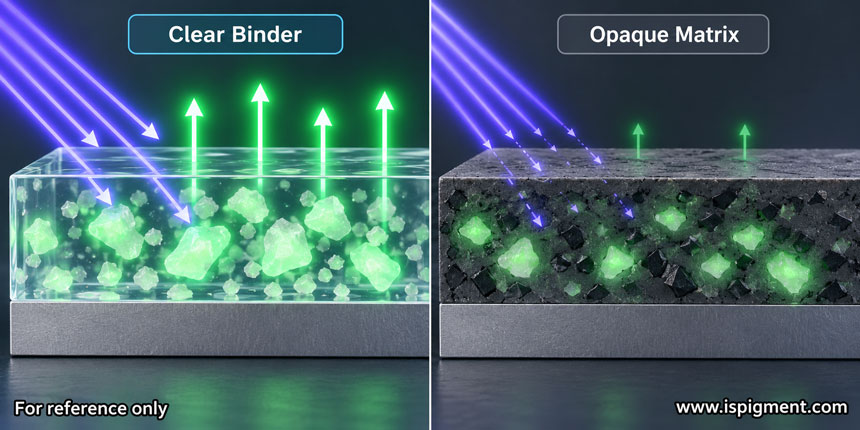
Experimental work on phosphor-containing coatings supports the conclusion that coating architecture matters. Comparative testing of SrAl2O4:Eu/Dy-containing surfaces prepared with different coating methods reported different surface-brightness and decay behavior.[5] The study does not make one binder universally superior, but it shows that finished structure can change phosphor performance.
|
System Condition |
Expected Tendency |
Why |
What to Check |
|
Clear, low-haze resin or binder |
Higher brightness potential |
More excitation light can reach the particles and more emitted light can leave the layer |
Transmittance, haze, film thickness, pigment loading |
|
Dark or strongly colored matrix |
Lower apparent glow is possible |
The matrix can absorb part of the excitation and/or emitted spectrum |
Colorant package, opacity, background, reference plaque |
|
Highly filled or scattering coating |
Reduced or less predictable output |
Fillers and interfaces can scatter or block optical paths |
Filler level, film build, surface texture |
For troubleshooting, a clear reference binder is valuable. If the raw pigment and a standardized clear-binder plaque perform well but the production formula does not, the main problem has shifted from raw pigment quality toward formulation or processing.
The statement “industrial mixing destroys glow pigment” is too broad. Mixing and milling are not the same operation. Low-shear incorporation, slow agitation, or controlled dispersion may simply distribute pigment through a carrier. By contrast, bead milling, ball milling, aggressive grinding, attrition, or repeated high-energy size-reduction steps are designed to fracture or reduce particles.
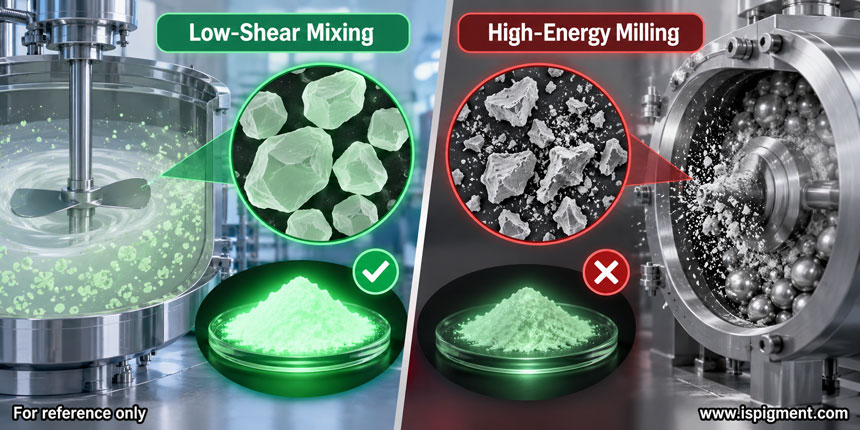
A Journal of Luminescence study directly examined ball milling of Eu2+/Dy3+-doped strontium aluminate phosphors and reported substantial luminescence loss as crystallite size was driven very low.[2] For industrial users, the practical conclusion is narrower than “do not mix”: do not subject a purchased glow pigment to unvalidated high-energy milling simply because the same equipment is routinely used for conventional color pigments.
At iSuoChem, we also screen thermal exposure separately from mechanical stress. As one representative example from our broader glow-pigment range, rather than a general limit for every grade, FCB35W lists a temperature resistance of 200°C. In thermally processed applications, we compare the actual material temperature and residence conditions with the specification of the selected grade before attributing brightness loss solely to shear or milling. Other models may have different temperature-performance limits.
Particle size creates a trade-off. Fine grades can improve smoothness, print definition, and compatibility with thinner films, while coarser grades may suit thicker decorative layers and can retain stronger afterglow in some systems. Coarse particles are not brighter because of “more surface area”; larger particles have lower specific surface area.
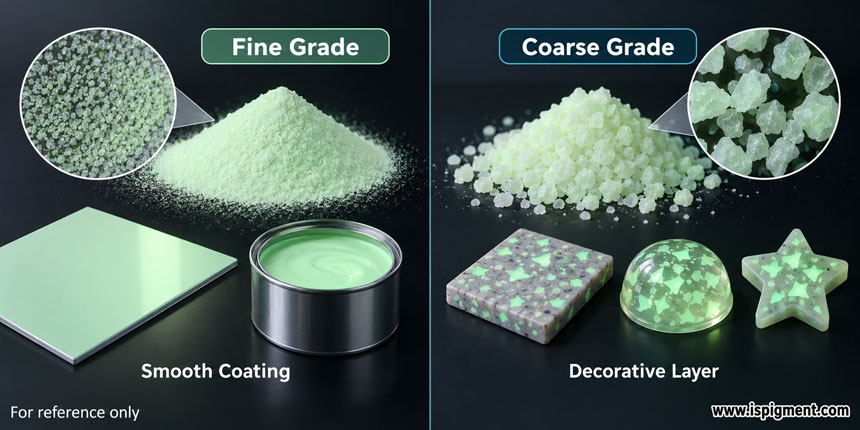
Research on SrAl2O4:Eu,Dy has shown that nano-sized material can exhibit greatly reduced brightness compared with coarser material, with surface-related effects proposed as an important factor.[3] This does not prove that every coarse commercial grade will outperform every fine grade. Composition, synthesis, dopant concentration, crystal quality, surface treatment, and test method also matter.
Fixed pigment percentages are convenient, but industrial formulation is system-specific. The optimum depends on active phosphor per area or volume, matrix transparency, processability, and required mechanical properties.
At low loading, too little active pigment may limit output. Increasing loading can help, but gains are not necessarily linear because higher solids can change viscosity, flow, adhesion, flexibility, roughness, sedimentation, and optical paths.
Film build is equally important. Two coatings with the same pigment percentage can contain different phosphor mass per square meter if their dry-film thicknesses differ. A thin printed or coated layer may contain too little active pigment, while a thick but opaque section may contain plenty of pigment yet limit excitation of deeper particles.
A useful engineering target is therefore not “maximum pigment percentage.” It is “maximum usable luminance while preserving application, mechanical, optical, and cost requirements.”
Moisture is one of the best-documented chemical risks for unprotected SrAl2O4:Eu2+,Dy3+. A study of the phosphor in water reported chemical instability and investigated hydrolysis-related changes in the material.[4] For water-containing manufacturing systems, humid environments, and outdoor products, the suitability of the pigment grade therefore deserves specific attention.
At iSuoChem, we separate incoming-powder moisture control from water introduced later during formulation or service. A low incoming moisture specification helps us establish the condition of the supplied material, but it does not remove the need to assess waterborne processing, storage humidity, or later environmental exposure.
The correct industrial response is not to conclude that strontium aluminate can never be used in waterborne coatings. Waterproof grades, surface treatments, compatible binders, and protective layer design can improve practical durability. What matters is whether the selected pigment is designed for the intended environment and whether later processing steps compromise that protection.
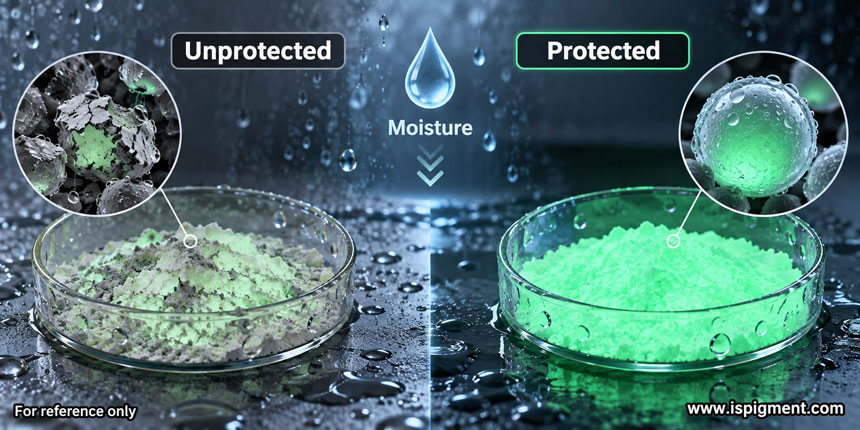
We also avoid treating “insoluble in water” as equivalent to “unaffected by prolonged water contact.” In compatibility screening, we consider contact duration and the chemical environment of the binder as separate variables, particularly in water-containing systems.
Glow pigments are dense inorganic particles, so settling can occur in liquid coatings, inks, and casting resins. But density difference is only one variable. Particle size, carrier viscosity, yield stress, thixotropy, agglomeration, surface treatment, mixing history, storage time, recirculation, and application delay all influence whether the final layer receives a uniform pigment concentration.
At iSuoChem, we consider particle size and density together with rheology and handling conditions when evaluating suspension behavior. These parameters help us interpret whether a selected grade is likely to remain uniformly distributed during storage, mixing, pumping, and deposition.
Uneven distribution may appear as local dark zones, batch variation, top-to-bottom differences in a container, or changing brightness during a production run. Adding more pigment without fixing suspension stability can increase cost while leaving the root cause unresolved.
A finished product can look weak even when the phosphor is intact. Dark or absorbing backgrounds can reduce apparent glow, while reflective backgrounds may improve visible output. This is an optical-system effect, not a universal brightness multiplier.
Ambient light also needs careful language. Bright factory lighting, emergency lighting, or stray daylight can reduce contrast between passive afterglow and the surroundings. That makes the glow harder to see, but it is not the same as a reduction in intrinsic afterglow luminance.
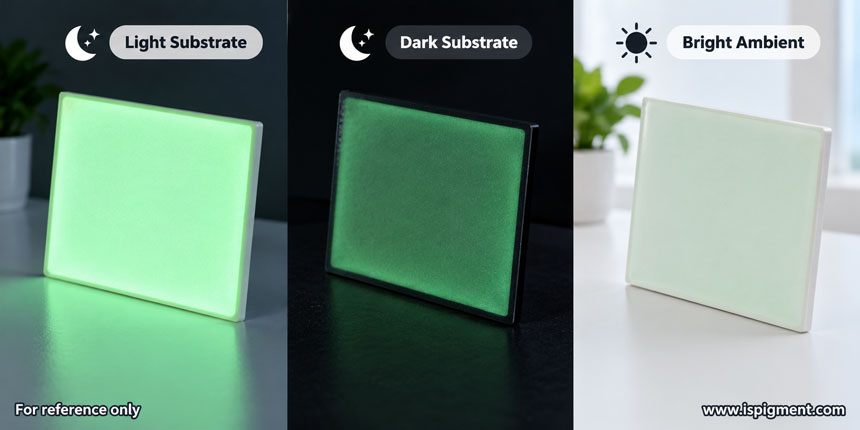
The same principle applies to charging. Samples excited under different spectra, intensities, distances, or exposure times should not be compared as if the conditions were identical. For industrial evaluation, excitation history and elapsed time after excitation must be controlled.[1]
Randomly changing the formula is inefficient because several causes can produce the same symptom. A staged comparison separates raw pigment capability from formulation and process effects.
At iSuoChem, we use product-specific technical data as troubleshooting reference points rather than as universal limits for all glow pigments. FCB35W is one representative grade from our broader photoluminescent pigment range; its data provide a practical example of how several parameters can be evaluated together when tracing brightness loss.
|
Parameter |
Example Value |
Troubleshooting Use |
|
Temperature resistance |
200°C |
Screens thermal exposure separately from mechanical shear. |
|
Water content |
<0.1% |
Helps distinguish incoming-powder condition from moisture introduced later. |
|
Water-contact pH |
10-12 after 100 h in water |
Adds a chemical-compatibility checkpoint for prolonged water contact. |
|
Particle size |
d50 about 30 µm; range 25-35 µm |
Connects grade selection with suspension, handling, and deposition behavior. |
|
Specific gravity |
3.4 g/cm³ |
Supports settling-risk assessment together with rheology and particle size. |
|
Afterglow benchmark |
140 mcd/m² at 10 min; 20 mcd/m² at 60 min |
Provides a quantitative reference for raw pigment, reference system, and finished product. |
|
Benchmark excitation |
1000 lx D65, 10 min, 23°C; DIN 67 510 Part 1 |
Keeps brightness comparisons reproducible under defined conditions. |
These values apply only to this representative grade and should not be read as specifications for the entire iSuoChem glow-pigment range. Their purpose here is to illustrate how quantitative product data can help separate raw-material condition from formulation and processing effects.
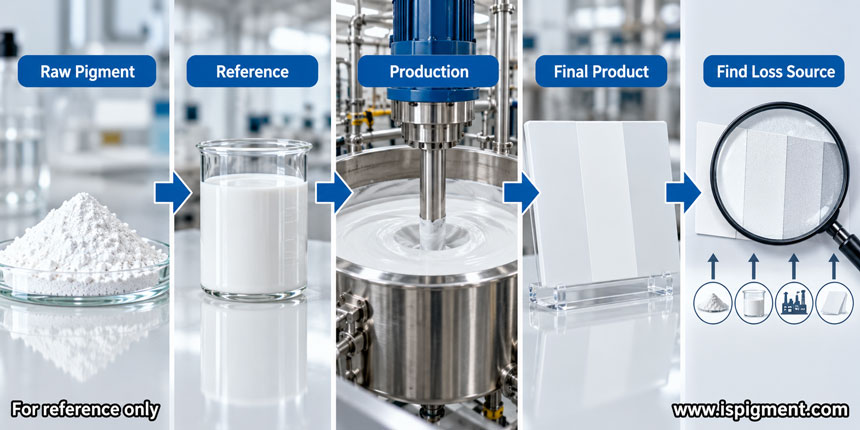
Keep a retained sample and test it under a defined excitation source, distance, exposure time, dark interval, and measurement geometry. Record luminance at fixed elapsed times rather than relying only on phone photographs or subjective dark-room impressions.
Use a known transparent or low-haze binder compatible with the pigment. The purpose is not to reproduce the final product, but to determine whether the pigment retains expected glow after simple incorporation.
If the clear reference performs well but the production formula is weak, investigate colored pigments, fillers, opacity, UV absorbers, haze, and film build. If both are weak, review pigment history, moisture exposure, and whether the process included milling or severe size reduction.
Where practical, compare particle-size distribution or microscopy before and after a high-energy process. A strong shift toward finer material supports a processing-damage hypothesis, especially when bead milling, ball milling, or grinding was used.[2][3]
For waterborne systems or humid processes, confirm that the pigment grade has appropriate protection. Untreated strontium aluminate has documented water sensitivity.[4]
Do not evaluate concentration in isolation. Control dry-film thickness, deposited mass, print-layer thickness, or part geometry, and confirm that the pigment remains uniformly distributed during storage and application.
|
Observed Symptom |
Likely Cause |
First Check |
Do Not Assume |
|
Raw powder is bright; finished coating is uniformly dull |
Matrix optical loss or insufficient effective luminous layer |
Clear-binder reference, film build, opacity/fillers |
Pigment batch failure |
|
Brightness drops after a grinding step |
Mechanical damage or excessive size reduction |
Process route and particle condition before/after milling |
All mixing is destructive |
|
Waterborne formula loses performance over time |
Moisture attack or inadequate protection |
Pigment grade and water exposure |
All waterborne systems are unsuitable |
|
Bottom of container gives a different result than the top |
Sedimentation or non-uniform distribution |
Storage stability, agitation, rheology, hold time |
Density alone is the cause |
|
Higher pigment loading creates processing problems |
Loading/formulation trade-off |
Viscosity, film build, mechanical properties, luminance |
One universal percentage works |
|
Common Statement |
More Accurate Engineering View |
|
“If the powder is high brightness, the finished product must also be high brightness.” |
Finished luminance depends on processing, matrix optics, loading, layer geometry, distribution, and test conditions. |
|
“All industrial mixing damages the pigment.” |
High-energy milling and severe comminution are documented risks; controlled incorporation is different. |
|
“The smaller the particle, the better the pigment.” |
Fine grades can improve finish, but very fine material can show lower luminescence. |
|
“More pigment always means more usable brightness.” |
Loading must be optimized together with viscosity, film build, opacity, mechanics, and dispersion. |
|
“If it looks weak under factory lights, the pigment has failed.” |
High ambient illumination may reduce visual contrast; intrinsic luminance should be evaluated under controlled conditions. |
For industrial users, the most efficient sequence is usually to preserve the pigment’s existing optical performance before increasing its formulation percentage.
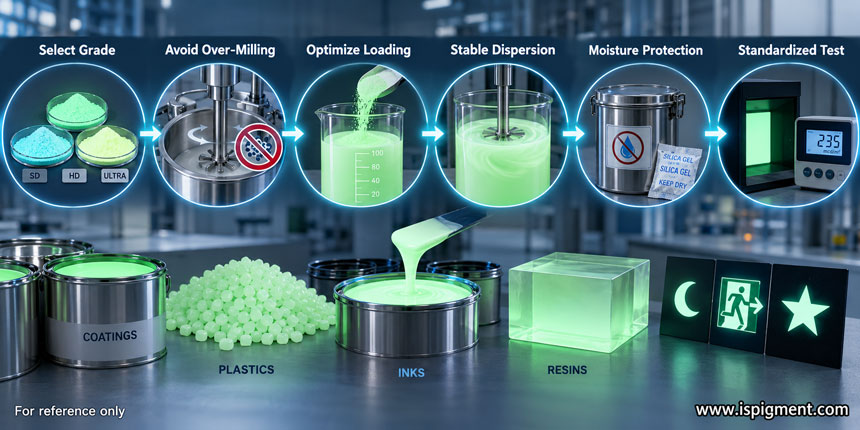
1.Confirm the correct pigment grade. Match glow color, particle size, moisture resistance, and application method to the final product.
2.Remove unnecessary destructive processing. If the pigment is being bead-milled or ball-milled simply because the standard color-pigment process uses that equipment, test adding the glow pigment after the grinding stage.
3.Improve optical access. Reduce unnecessary opacity around the glow pigment when product design allows it and compare the production formula with a clear or lower-haze reference system.
4.Optimize loading together with layer geometry. Run a controlled concentration series while holding film thickness or part geometry constant and measure luminance rather than selecting the highest percentage by intuition.
5.Control suspension and distribution. For liquid systems, evaluate rheology, storage stability, agitation, pot life, and application delay.
6.Protect moisture-sensitive grades. For waterborne or humid applications, use a suitable protected grade and avoid process steps that may compromise the protective surface.
7.Standardize the brightness test. Use the same excitation source, intensity, distance, exposure time, dark interval, sample thickness, and measurement geometry when comparing formulations.
When a glow in the dark pigment looks bright as a raw powder but dull after industrial processing, the result should not be explained automatically by short charging time, poor pigment quality, or insufficient loading. A more reliable explanation considers the complete system.
Persistent strontium aluminate phosphors depend on crystal and trap behavior.[1] High-energy milling and excessive size reduction can reduce luminescence.[2][3] Untreated strontium aluminate is vulnerable to moisture,[4] while coating architecture can change the usable brightness of the finished surface.[5]
For manufacturers, the practical implication is straightforward: protect the pigment from destructive processing, match particle size and moisture resistance to the application, optimize loading and film build, maintain uniform dispersion, and compare products under controlled excitation and measurement conditions. The goal is to preserve the pigment's optical potential throughout the industrial system.
แท็ก :
ลิขสิทธิ์ © 2026 iSuoChem.สงวนลิขสิทธิ์.
ทีมงานมืออาชีพในการให้บริการ !
 web@ispigment.com
 +86 13965049124
 ไทย
ไทย  English
 français
 русский
 italiano
 español
 português
 العربية
 한국의
한국의 Tiếng Việt


